How an Artist's Chart Run Should Shape Your US Festival Calendar
Track an artist's chart momentum to predict US festival billing tiers and book tickets before prices and crowds outpace the experience.
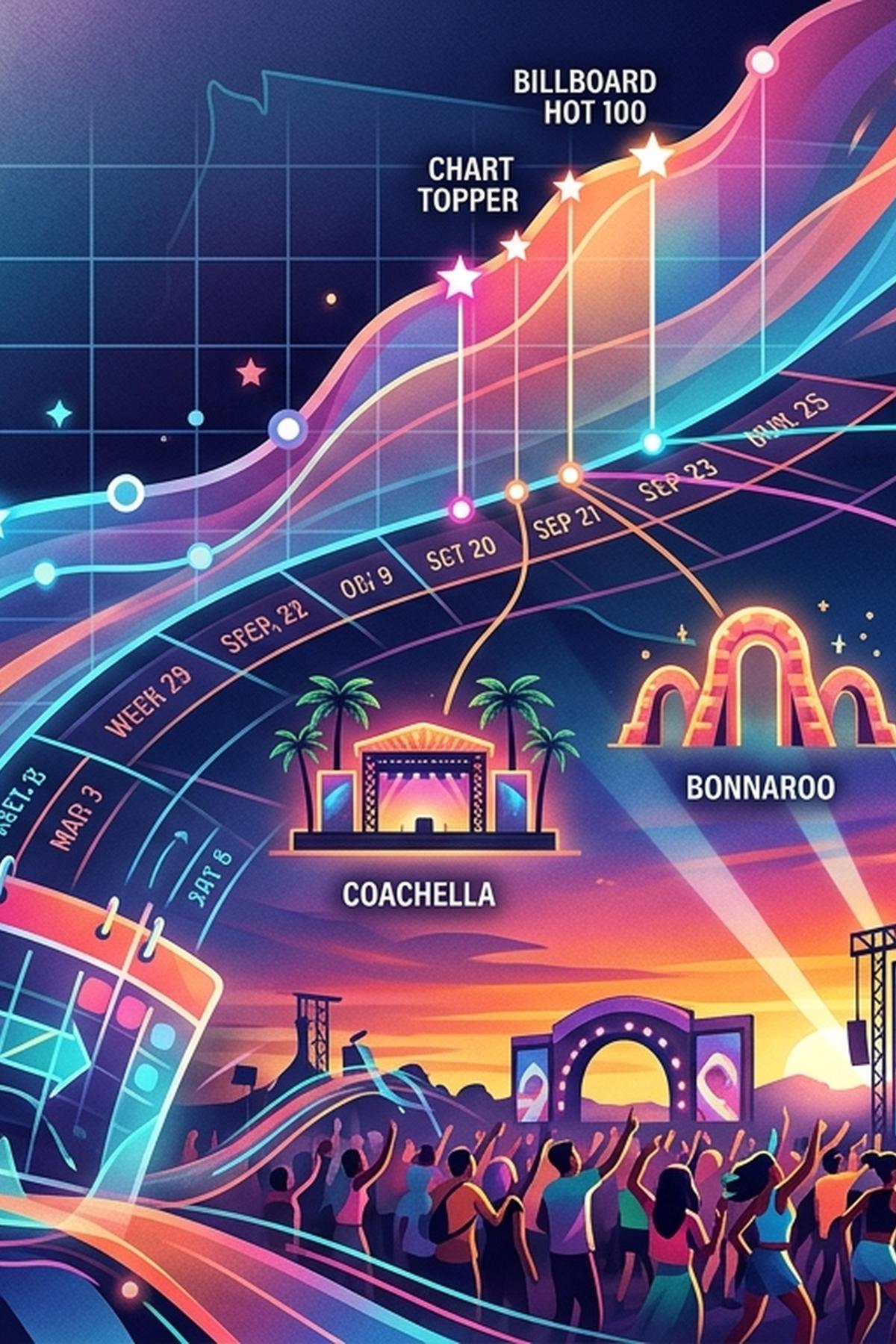
The moment a festival lineup drops, prices jump. The crowd that was already planning has already bought. They were not refreshing the announcement page. They were watching the charts.
If you have spent time planning US music trips, you will know the frustration. An act you caught in a 5,000-capacity tent last August is now closing a main stage. The tickets you could have grabbed for $180 are listed at $420, and the set is in front of 40,000 people. That window closed. You missed it because you were tracking the wrong signals.
Chart trajectory is the right signal. An artist's commercial momentum in the US market is not just a popularity metric. It is a map of where they are heading on a festival bill, and how fast they are getting there.
Chart momentum is the earliest reliable indicator of where an act will appear on a US festival lineup, and at what scale.
- An artist holding the top 40 for 12 or more weeks is almost certainly in active festival negotiations for the following summer.
- Billing tier, from small secondary stage to main stage closer, tracks closely with both peak chart position and how long the run lasts.
- The best time to buy is before the wider audience connects the chart run to the festival announcement, typically a gap of three to six months.
How Chart Position Translates to Stage Size
Festival bookers work 12 to 18 months ahead of the event. They are not booking who is famous right now. They are betting on who will fill a field when the gates open. The most reliable way to make that same bet as a ticket buyer is to track where an artist sits in the US charts and, more tellingly, which direction they are moving.
The general pattern holds consistently across the US festival circuit. An act with a song climbing the Hot 100 chart in the final quarter of one year will almost certainly appear at a major US festival the following summer. The question is at what billing tier. A debut entry in the top 40 tends to land an act in a mid-afternoon slot on a secondary stage. A sustained top 10 presence, or multiple charting tracks, tends to push them into late-afternoon positioning or direct support billing. A number one single that holds its position puts them in direct conversation with main stage closing slots.
This is not a guarantee. Streaming spikes, viral moments, and media cycles can compress or extend that timeline. But the chart pattern is still the most consistent predictor available to anyone building a festival calendar from outside the industry.
Momentum Matters More Than Peak Position
Peak chart position is the number everyone fixates on. Momentum is what actually matters for festival planning purposes.
An artist who hits number 23 and holds that position for three months has built something different from an artist who briefly touches number 8 and then disappears. A booker reads sustained presence as audience confidence. It signals that people are not just discovering the track, they are returning to it. That listening behaviour translates directly into ticket-buying behaviour at the festival level.
For the festival traveller, the sweet spot is an artist with a 12 to 20-week chart presence in the top 40 who has not yet crossed into arena-level headliner territory. At that point, they are almost certainly already booked on a festival circuit. They are playing secondary or tertiary stages at the bigger events. Ticket prices still reflect the overall lineup rather than any single act's star power. The crowd at their slot is large enough to feel electric but small enough to feel close.
That is the window. At most, it is 18 months wide. Often it is shorter than that.
The Five Phases of a Festival Career
Knowing where an artist sits in their commercial cycle tells you not just whether to see them, but which festival to book and when. The trajectory tends to follow a recognisable pattern, and each phase carries a different kind of live experience.
- Debut charting: A breakthrough track enters the Hot 100 for the first time. The artist starts appearing on boutique or genre-specific lineups in smaller US markets. Tickets are inexpensive. Slots are early in the day. The audience is almost entirely core fans. This is worth watching closely and acting on quickly once you spot it.
- Sustained climb: Multiple tracks are charting, or one track has held for over ten weeks. Major US festivals begin booking them for afternoon slots on secondary stages. This is the time to commit to your plan. The mainstream audience has not caught up yet, and pricing reflects that.
- Top 10 presence: The artist is now in the wider cultural conversation. Festival billing shifts to late afternoon on a secondary stage or a mid-bill position on the main. Crowd sizes at their slot grow sharply. Ticket demand rises to match.
- Post-peak arena phase: The artist is headlining their own arena tour. Festival billing moves to co-headliner or closer. Prices and crowd sizes reflect full mainstream saturation. The intimate window has passed.
- Legacy mode: Chart presence is minimal or anniversary-driven. Festival billing is typically nostalgia-led. It can be a genuinely powerful experience, but the crowd dynamic has shifted entirely from the earlier phases.
None of these phases has a fixed duration. A viral moment can compress phases two and three into a matter of weeks. A quiet period between releases can hold an artist in phase two for two full festival seasons, giving attentive travellers more time than usual to plan around them.
Where Chart-Climbers Typically Land on the US Festival Map
Different US festivals operate at different points in the chart cycle, which gives you a practical way to match your travel plans to the kind of experience you are actually after.
Coachella, running since 1999, has a documented tendency to book artists in phases two and three for its second and third stage positions, often several months before those acts cross into arena headline territory. That makes it one of the better major festivals for catching phase-two artists in a context that still feels proportionate to their current audience size.
Lollapalooza in Chicago and Austin City Limits in Texas operate on similar instincts but tend to move slightly faster on regional acts with strong streaming numbers in their catchment areas. Both festivals reward the traveller who is willing to look past the headliner tier and treat the afternoon billing as the strategic part of their day.
Bonnaroo leans toward sustained chart presence over peak position, which often makes it a better festival for catching phase-two artists than those driven more by viral singles. If an act has maintained a consistent chart presence for six months or more without one breakout moment propelling it, Bonnaroo is frequently where they show up first at a meaningful billing position.
Smaller regional festivals in the Southeast and Mountain West frequently catch phase-one and early phase-two artists before the larger markets respond. If you are willing to travel to those events, you will consistently see artists two or three billing tiers below where they will be in 12 months. The price is lower, the proximity to the stage is genuinely different, and the experience belongs to a category the major-festival circuit cannot replicate.
Catching the Same Act: How the Experience Shifts Across Chart Phases
| Chart Phase | Typical Festival Slot | Crowd Scale | Ticket Cost Impact |
|---|---|---|---|
| Phase 1: Debut charting | Boutique or specialist festival, small stage | 500 to 2,000 | Minimal, low entry price |
| Phase 2: Sustained top 40 | Mid-tier US festival, secondary stage | 3,000 to 10,000 | Moderate, priced by lineup not star power |
| Phase 3: Top 10, multiple hits | Major US festival, late-afternoon main stage | 15,000 to 30,000 | High, demand-driven pricing |
| Phase 4: Arena-level post-peak | Co-headliner or festival closer | 30,000 and above | Very high, premium tier throughout |
Building a US Festival Itinerary Around the Chart Cycle
The practical version of this framework starts with one simple habit: check chart positions for artists you already follow, once a month, across a six-month window. You are not looking for a snapshot. You are looking for direction and duration.
Pick four or five artists whose music you would genuinely travel to see. Plot where each sits in the five-phase cycle described above. For those in phases one and two, look at which festivals have already announced early lineup waves for the next 12 to 18 months. Cross-reference the festival's billing history with the artist's current trajectory. If the pattern lines up, act. The gap between that moment and when the general audience makes the same connection is where your value lies as a planner.
For artists in phase three, accept that the festival experience will be different. Not necessarily worse, but different. You are seeing them at the point where their audience has expanded well past the core fanbase. That can be electric in its own right, with the kind of communal energy that only comes from a very large crowd all knowing every word. It can also mean pushing through a field of 25,000 people to find a decent sightline.
The most satisfying festival itineraries tend to be built across phases. Catch a phase-one act at a smaller regional event in spring. See a phase-two artist at a mid-tier festival in early summer. Let a phase-three artist anchor the main event in August, with full awareness of what that crowd and price tag will look like. That spread keeps the calendar varied, the budget manageable, and the range of experiences genuinely different from one trip to the next. A single-festival approach almost never achieves the same result.
When the Chart Tells You the Window Has Already Shut
There is a specific, uncomfortable moment in festival planning when you realise the artist you had in mind has moved past the experience you were hoping for. The chart tells you when that has happened, if you pay attention.
An artist whose most recent record has no Hot 100 presence, who is headlining arenas on their own, and whose festival appearances now come with co-billing and dedicated fan sections spread across a massive field, is past the phase-two window. They are still worth seeing. But the experience belongs to a different category from what you originally pictured.
That same artist, 18 months earlier, in a tent holding 8,000 people at a mid-tier festival, playing to an audience that still felt like it belonged entirely to them, was a fundamentally different proposition. The stage was smaller. The sound was closer. The people around you had found the music the same way you did.
Knowing the difference between those two experiences, and having the chart history to spot which one is ahead of you, is what separates a festival itinerary built around real music travel from one built around whichever lineup poster is generating the most noise on social media this week. The chart does not tell you what to enjoy. It tells you when to move.